On this page
    ← Blog · Web Design · · 10 min read

    Why Your Electrician Website Is Slow (and 5 Reasons It's Costing You Leads).

    Most electrician websites score under 60 on Google PageSpeed. That suppresses Map Pack rankings, kills mobile conversion, and blocks Google AI Overview citations. The 5 reasons your site is slow plus the real fix. Newman Electric: 99 mobile / 100 desktop.

    Michael Rupe, Co-Founder & SEO Director at Savo Group
    Co-Founder & SEO Director ·
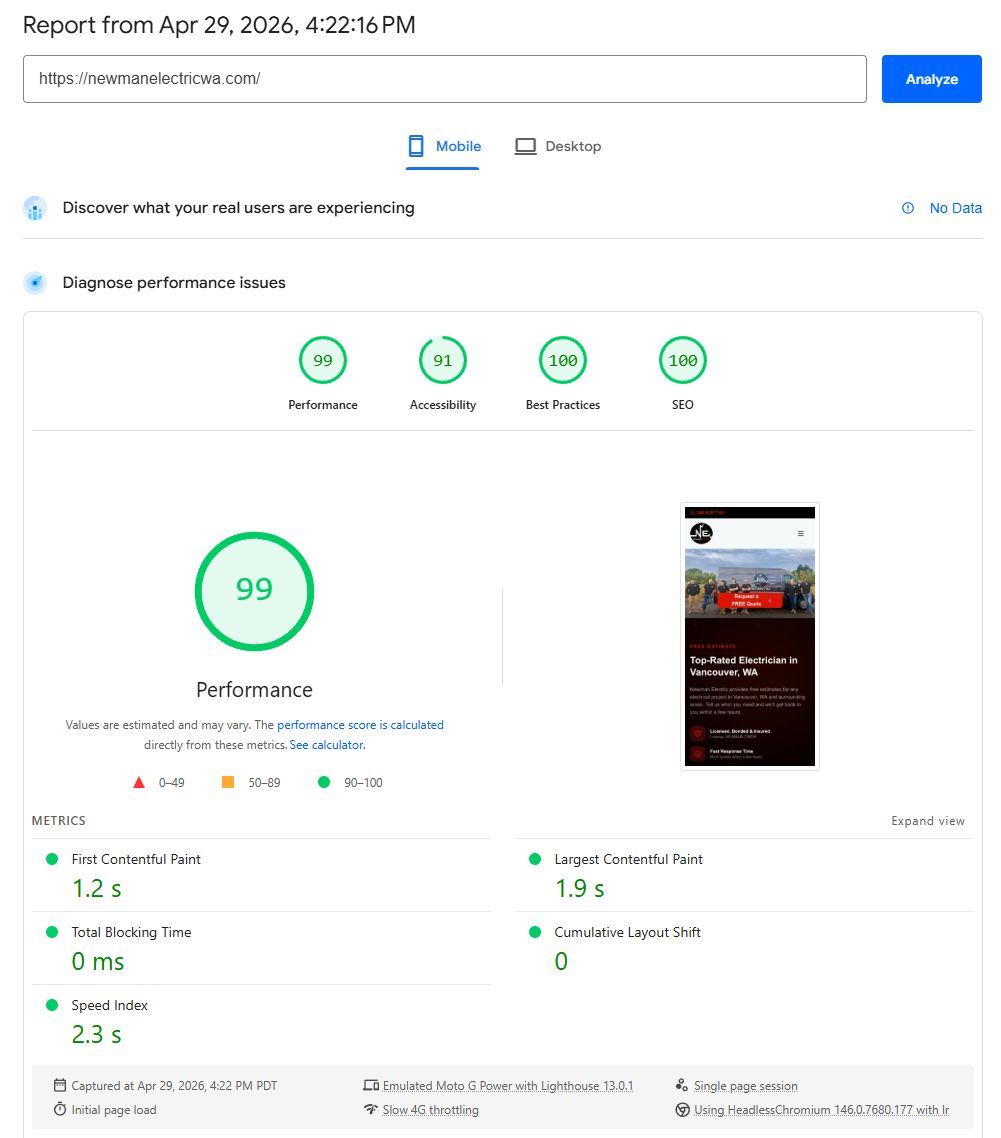
    Newman Electric scoring 99 mobile on Google PageSpeed Insights
    The short version

    Most electrician websites are slow because they're built on WordPress with a page builder, hosted on shared cheap hosting, and loaded with 8 to 15 plugins. The combined weight ships 3 to 5 megabytes of JavaScript on every page load, drives Google PageSpeed scores into the 30s and 40s, and suppresses Map Pack rankings, organic positions, AND Google AI Overview citations simultaneously.

    The fix isn't more SEO work or more plugins. It's a hand-coded website built with modern static-site tools (Astro, Next.js static export) deployed to an edge network. the Newman Electric case study scores 99 mobile / 100 desktop on Google PageSpeed Insights with this approach. The same approach applied to any electrician business produces parallel rankings + AI citations because the underlying website foundation is what compounds.

    The 5 reasons your electrician website is slow

    Almost every slow electrician website we audit comes down to the same five culprits, in roughly this order of impact:

    1. 1

      Page builder bloat

      Biggest culprit

      WordPress page builders (Elementor, Divi, WPBakery, Beaver Builder, Brizy) load 100 to 300 KB of JavaScript on every page just to render the layout. That JavaScript runs before any content paints. On mobile networks, this single factor pushes Largest Contentful Paint above 4 seconds on most contractor sites we audit. Replacing the builder with a lightweight theme typically jumps PageSpeed 20 to 30 points overnight.

    2. 2

      Plugin sprawl

      12–18 typical

      The typical electrician WordPress site has 12 to 18 plugins active. Each one ships its own JavaScript, CSS, and often database queries on every page. Worst offenders: heavyweight contact-form plugins, slider plugins, duplicate-schema SEO plugins, fighting cache plugins, backup plugins running cron during page loads, and stacked tracking pixels. Realistic diet: under 8 active plugins, each justifying its presence.

    3. 3

      Cheap shared hosting

      TTFB 800ms+

      GoDaddy / Bluehost / HostGator shared plans run thousands of sites on the same hardware. Time to First Byte commonly hits 800ms to 2 seconds. Managed hosts (Kinsta, WP Engine, Cloudways, Pressable) deliver TTFB under 200ms for $30–$100/month. The upgrade alone lifts PageSpeed 10 to 15 points and pays for itself in conversion lift on any business doing $10K+/month.

    4. 4

      Unoptimized images

      20–50MB pages

      Most electrician sites serve 4MB hero JPEGs at 4000×3000, scaled down by the browser. Multiply across project galleries, before/afters, team headshots, and you've shipped 20–50MB per page load. Convert everything to WebP, serve at actual display size, lazy-load below the fold, image weight drops 60–80% and mobile load drops 1–2 seconds.

    5. 5

      No edge caching / no CDN

      200–500ms tax

      A traditional WordPress site sits on one server in one location. Modern static stacks (Cloudflare Workers Assets, Vercel Edge, Fastly) serve every page from the closest edge to the visitor. For multi-city electricians, edge caching cuts 200 to 500ms off every load, cumulatively 5–10 PageSpeed points and 5–15% lift on mobile conversion.

    What slow websites cost an electrician business

    The cost of a slow electrician website isn't theoretical. Three measurable losses:

    Lost mobile conversions

    Bounce rate jumps 32% from 1s → 3s load, 90% from 1s → 5s. A 4-second mobile site loses roughly half its potential phone calls before customers see the contact form.

    Suppressed Google rankings

    Core Web Vitals are explicit ranking signals. Below 50 mobile = downranked. Above 90 = small boost. The gap compounds across every dollar spent on SEO.

    Blocked AI Overview citations

    Google AI Overview's crawler often times out on JS-heavy WordPress sites before content renders. Slow + thin schema = cited far less than fast static HTML competitors.

    The Newman Electric benchmark

    the Newman Electric case study runs a hand-coded Astro website deployed to Cloudflare Workers Assets. Verifiable performance numbers (run your own test at pagespeed.web.dev):

    Mobile PageSpeed

    99

    Desktop PageSpeed

    100

    First Contentful Paint

    1.2s

    Largest Contentful Paint

    1.9s

    Total Blocking Time

    0ms

    Cumulative Layout Shift

    0

    The downstream compounding: Newman ranks for 295 keywords, gets 173 AI Overview citations, appears in 130 Map Pack results. The website is the foundation that everything else compounds on top of. A slow website caps the program; a fast website unlocks it.

    Hand-coded vs WordPress: when each makes sense

    Hand-coded (Astro / Next.js)

    Best for:

    • Multi-truck contractors
    • Multi-city service areas (5+ cities)
    • Commercial-electrical focus
    • Aggressive SEO + AI SEO program
    • PageSpeed 95+ requirement
    • Long-term ROI horizon

    Cost: $8,000 to $25,000 one-time

    i Optimized WordPress

    Best for:

    • Solo electrician businesses
    • Single-city service areas
    • Residential-electrical focus
    • Modest SEO program
    • PageSpeed 70–85 acceptable
    • Short-term cash flow priority

    Cost: $2,000 to $5,000 + $50/mo hosting

    WordPress works for electricians; the constraint is the performance ceiling. A well-built WordPress site can hit 80+ PageSpeed; a hand-coded site hits 95+. The marginal cost of the hand-coded build pays for itself once the SEO program is producing 5+ leads per month, because the lift on every existing lead-generation channel compounds.

    What to do this week

    1

    Test your current site

    Run your homepage through pagespeed.web.dev. Below 60 mobile = emergency. 60–80 = significant room. 80–90 = refining. 90+ = doing well.

    Run PageSpeed
    2

    Identify the blocker

    The report breaks down which resources are slow. Biggest offenders for electrician sites: render-blocking JavaScript (page builders), unoptimized images, slow TTFB.

    3

    Decide on the fix

    WordPress optimization caps at ~85 PageSpeed for $1.5K–$4K in agency time. Hand-coded rebuild hits 95+ for $8K–$25K one-time. Pick based on business stage and SEO ambition.

    Free SEO Report
    Web Design · FAQ

    Common electrician website performance questions.

    For mobile (the score that matters): 90 or higher is good, 95 to 100 is excellent. Below 60 is failing. The Newman Electric case-study website scores 99 mobile / 100 desktop on Google PageSpeed Insights, verifiable at pagespeed.web.dev. Most electrician WordPress websites we audit score in the 30 to 55 range, which actively suppresses Google rankings regardless of how much SEO content has been added on top.

    Yes. Google's ranking algorithm explicitly weights Core Web Vitals: Largest Contentful Paint (LCP), Cumulative Layout Shift (CLS), and Interaction to Next Paint (INP). Slow sites get downranked. AI Overview specifically downranks slow sites because the underlying content is harder to crawl and parse. The compounding effect: a slow electrician website can spend $5,000/month on SEO and rank below a fast competitor spending $1,500/month, because Google's quality threshold is binary.

    WordPress itself isn't the problem. Most electrician WordPress sites use page builders (Elementor, Divi, WPBakery, Beaver Builder) that load 200KB+ of JavaScript on every page just to render the layout. Stack a typical contractor theme + 8 to 12 plugins + a chat widget + Google Tag Manager + Facebook Pixel + a slider + retargeting tags, and you're shipping 3 to 5MB of JavaScript before any actual content renders. The result: 3 to 5 second mobile load times, PageSpeed scores in the 30s and 40s, and bleeding mobile conversions.

    Sometimes. The high-leverage moves: switch to a managed host (Kinsta, WPEngine, Cloudways) instead of GoDaddy/Bluehost; replace the page builder with a lightweight theme (GeneratePress, Astra, Kadence); reduce plugins to under 8; lazy-load images and convert all to WebP; install a properly-configured caching plugin (WP Rocket, FlyingPress); enable Cloudflare APO. Realistic ceiling: 75 to 85 mobile PageSpeed. Above that requires a hand-coded rebuild because the underlying WordPress architecture imposes a performance floor that page builders push through.

    Typically $8,000 to $25,000 one-time, depending on the size of the service catalog, number of cities targeted, photography, copywriting, and whether it's paired with the SEO and PPC programs. Newman Electric's website cost in this range and produced 295 ranking keywords + 173 AI Overview citations + 130 Map Pack appearances over 24 months. The math typically works in electricians' favor: a single panel upgrade or EV charger install per month from organic search comfortably covers the build over the life of the site. See electrician web design pricing.

    For the highest performance ceiling, electrician websites should be built with a static-site generator like Astro (what Savo Group uses) or Next.js with static export, deployed to a global edge network like Cloudflare Workers Assets or Vercel. The output is static HTML + minimal JavaScript that loads in under 2 seconds on mobile. WordPress is workable for smaller electrician businesses if paired with proper hosting, a lightweight theme, and a strict plugin diet, but the performance ceiling caps in the 80s on Google PageSpeed. Hand-coded Astro sites score consistently 95+ on PageSpeed Insights.

    Yes, indirectly. Google AI Overview prefers to cite pages that load quickly because the underlying crawler can extract content reliably. Slow sites with heavy JavaScript rendering (the typical WordPress + page builder stack) often have content that AI engines never see because the crawler times out before JavaScript renders. The result: an electrician website with thin schema, slow load, and heavy JS gets cited in AI Overview far less than a competitor with fast static HTML and full schema. See AI SEO for electricians.

    Run your homepage through pagespeed.web.dev (free, official Google tool). Look at the mobile score, not the desktop score; mobile is what Google uses for ranking. Pay attention to the four Core Web Vitals at the top: LCP under 2.5s, CLS under 0.1, INP under 200ms, FCP under 1.8s. If any of these are red, your site has a real performance problem affecting both rankings and conversion. Test the homepage, your top service page, and your most-trafficked city page; they often perform differently.

    Free electrician SEO Report.

    We'll run your site through Google PageSpeed Insights, identify the specific bottlenecks (page builder, plugin sprawl, hosting, images), and recommend the right fix for your business stage. Free, no commitment.

    Family-owned electrician marketing agency · 27+ years of experience

    Request a custom quote