
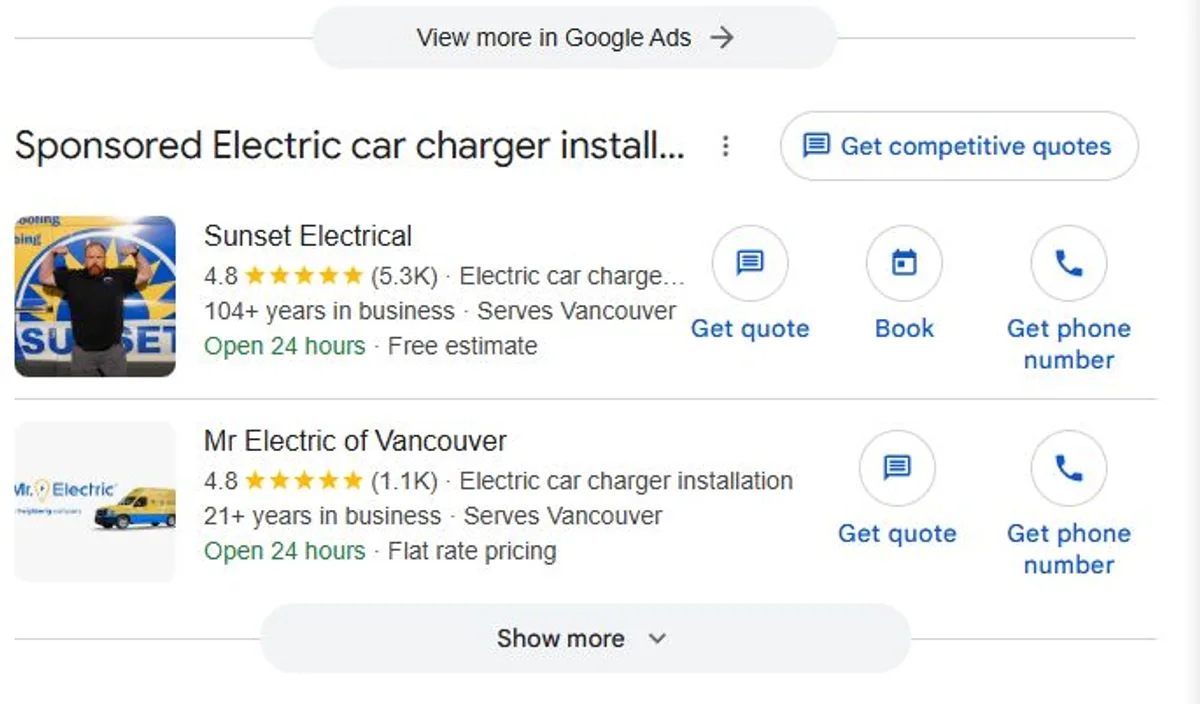
The three channels side-by-side
| Attribute | LSA | Google Ads | SEO |
|---|---|---|---|
| Pricing model | Pay-per-lead | Pay-per-click | Monthly retainer |
| Time to first lead | 2-4 weeks (verification) | 24-48 hours | 1-2 months |
| Cost per lead (PNW 2026) | $25 to $80 | $40 to $120 | $0 (after retainer) |
| Scale ceiling | Limited by service area + verifications | Limited by ad spend + auction | Compounds indefinitely |
| Lead quality | Highest (pre-qualified by Google) | High (high-intent click) | Highest (organic trust) |
| What you stop getting if you stop paying | All leads, immediately | All leads, immediately | Most leads compound for months |
| Setup complexity | High (background, license, insurance) | Medium | High (foundational) |
| Algorithmic risk | Low | Low | Medium (algorithm changes) |
Local Service Ads (LSAs)
The pay-per-lead result above traditional Google Ads. The green Google Guaranteed badge is the visual signal. LSAs are the fastest path to qualified leads for electricians once verification completes.
How LSAs work
License + insurance + background check
Google verifies the electrical contractor license, business insurance, and runs background checks on owners
Top-of-SERP placement
Your LSA appears above traditional ads for relevant electrician queries in your service area
Pay-per-lead, not per click
Customer calls or messages from the LSA, you only pay for qualified leads
Lead disputes available
Dispute spam, wrong-service-area, or wrong-service leads to get refunds
When LSAs work best for electricians
"Near me" + emergency queries
LSAs win the highest-converting customer-intent result type
Mature review profile (25+)
Under 10 Google reviews limits visibility
Defined service area (1–5 cities)
Scales poorly for 20-city service areas
Residential focus
Commercial coverage is thinner than residential
Traditional Google Ads (Search + Performance Max)
Pay-per-click ads on the Google search results page. The fastest channel for new electrician businesses to start generating leads.
How Google Ads works
Keyword bidding
Bid on terms like "panel upgrade [city]" or "EV charger installer [city]"
Search-results placement
Ad appears for matching searches
Pay-per-click (CPC)
You pay when someone clicks, whether or not they call afterward
Performance Max variant
Cross-channel automated bidding for mature accounts
Where Google Ads beats LSAs for electricians
Service-specific queries
"EV charger installation [city]" or "commercial electrical [city]", LSAs don't always cover these specifically
New businesses with under 10 reviews
LSAs underperform without review depth; Search Ads bid into the same auction without that constraint
Multi-city service areas
Search Ads geo-target ZIP-precision across 20+ cities; LSAs work best for tighter service areas
Commercial-electrical work
B2B query patterns are better served by Search Ads with targeted ad groups
SEO (Map Pack + organic + AI Overview)
The compounding investment that produces leads at zero per-lead cost once the program matures. Slowest to start, hardest to displace once established.
How electrician SEO works
Google Business Profile optimization
Citations, reviews, NAP, posts, Map Pack ranking
Service + city pages on the website
Organic SEO across the customer-intent query cluster
Comprehensive schema markup
AI SEO foundation for Google AI Overview citation
Continuous review generation
Map Pack + AI Overview signals compound monthly
The compounding advantage
Google Ads delivers 100 leads month 1 if you spend $5,000. Stop spending month 13: zero leads month 14. SEO delivers 5 leads month 1, 20 leads month 6, 80 leads month 12, 100+ leads month 18. Stop paying the SEO retainer month 13: still 60–80 leads month 14, decaying slowly.
That compounding is why our client Newman Electric went from a nearly dead phone to 114 calls straight from Google between February and May 2026, up 48% over the same stretch a year earlier, backed by 295 ranking keywords, 173 AI Overview citations, and 130 Map Pack appearances at month 24. The early-month ROI looked worse than Google Ads; the cumulative ROI now beats it dramatically.
Recommended sequence by business stage
Stage 1
New electrician business
- • Month 1: Launch Google Ads (immediate leads)
- • Month 1: Start LSA verification
- • Month 1: GBP optimization + review system
- • Month 2: LSAs go live
- • Month 3+: Begin SEO foundation
Budget split: 60% Ads / 30% LSA / 10% SEO
Stage 2
Established (50+ reviews)
- • Balanced 3-channel program
- • LSAs are highest-ROI
- • SEO compounds in background
- • Google Ads fills service-gaps
- • Begin AI SEO + content investment
Budget split: 30% Ads / 30% LSA / 40% SEO
Stage 3
Multi-truck metro contractor
- • Paid scale ceiling becomes binding
- • Organic + AI SEO is the marginal-dollar advantage
- • 15+ city pages on website
- • Heavy AI Overview citation work
- • LSA + Ads maintained at lower share
Budget split: 25% Ads / 25% LSA / 50% SEO + AI SEO
The Newman Electric attribution data
The Newman Electric case study runs all three channels. Approximate monthly lead attribution after 24 months of compounding work:
The breakdown moved from ~70% paid in month 6 to ~40% paid by month 24 as SEO compounded. Total lead volume roughly tripled over the same period at the same monthly marketing spend. That's the compounding ROI a balanced 3-channel program produces.
What to do this week
Map your current channel mix
Pull the last 90 days of phone-call sources. What % came from organic, LSAs, Google Ads, direct? Most electricians can't answer this, that's the first fix.
Pick the right next channel
New business: Google Ads first. Established with 25+ reviews: LSA verification this month. Multi-truck: SEO + AI SEO is the marginal-dollar lever.
Set 90-day attribution
Conversion tracking on every channel. Without it, you can't tell which channel earned the lead, and you'll over-spend on the loudest one.